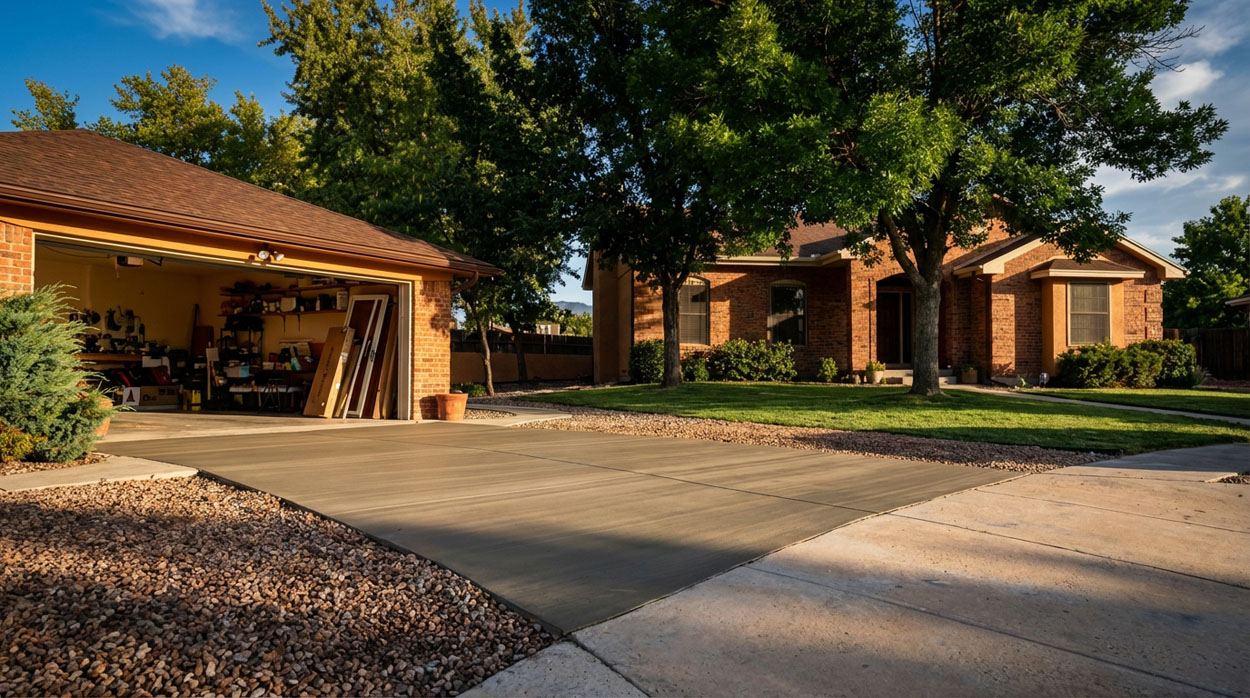
Long driveways, estate patios, equestrian concrete, block walls, and decorative finishes for Corrales' large-lot properties and rural character.
Tell us about your Corrales project — we'll get back to you fast.
The Village of Corrales is a semi-rural equestrian community of roughly 8,500 residents on the west bank of the Rio Grande, sandwiched between Albuquerque and Rio Rancho. With a one-dwelling-per-acre zoning ordinance in place since incorporation in 1971, properties here are large — and that changes the scope of every concrete project. A driveway in Corrales can run 150 to 400 feet from the road to the house. A patio pour might cover a portal that wraps around an adobe estate home. And equestrian properties routinely need barn pads, horse wash stations, trailer-loading aprons, and arena edging that you'd never encounter in a typical residential community.
Corrales soil presents its own challenges. The village straddles two terrain zones: the inner valley along the Rio Grande with alluvial, sandy soil and a higher water table, and the piedmont rising toward Rio Rancho with looser, wind-deposited sand over caliche layers. Both zones require careful sub-base work, but for different reasons — the inner valley's drainage challenges versus the piedmont's unstable sandy base. The village's own permitting requires a Grading and Drainage Plan prepared by a licensed engineer, and driveway runoff cannot be diverted onto public streets — it must be retained on your lot.
Home values in Corrales are among the highest in the metro area, with a median around $550,000 and many properties well into seven figures. The homeownership rate is over 91%. These are established homeowners who invest in their properties for the long term and expect quality craftsmanship — not budget pours. Whether it's a stamped concrete patio that complements a territorial-style adobe home or a reinforced driveway engineered for horse trailer loads, we build to the standard Corrales homeowners expect.
~8,500
Population
~5,108 ft
Elevation
$550,000–$735,000
Median Home Value
Incorporated 1971
Established
Inner valley alluvial soils near the Rio Grande have a high water table — drainage engineering and moisture barriers are critical for slab longevity
Piedmont soils on the western side are loose, wind-deposited sand over caliche — sub-base compaction and stabilization are essential
Village ordinance requires all driveway runoff to be retained on the property — no diversion to public streets or bar ditches
A Grading and Drainage Plan by a licensed engineer is required for all building permits
Well and septic setbacks on every property (50–100 ft) affect slab and driveway placement
Acequia irrigation ditches cross many properties and must be protected during construction
Long driveways on 1-acre+ lots mean larger pours with more joints, reinforcement, and sub-base prep than typical residential work
Long driveways (150–400+ ft) on large-lot properties — the most common concrete project in Corrales
Estate patios and portal-area flatwork for adobe and territorial-style homes
Equestrian concrete: barn pads, horse wash stations, trailer-loading aprons, tack room floors, arena edging
Replacement of aging driveways and patios on 1970s–1990s homes reaching end of service life
Block walls and courtyard walls (placitas) that complement adobe architecture
Decorative and stamped concrete matched to Southwestern earth-tone color palettes
Acequia crossing bridges, culvert aprons, and drainage structures
The scenic byway that runs the length of the village. Properties along Corrales Road include some of the most established estates in the community, many with long driveways, mature landscaping, and aging concrete from the 1970s–1990s that needs replacement.
Lower-lying properties near the Rio Grande with fertile, irrigated land and higher groundwater. Adobe and territorial homes with acequia access. Concrete work here requires careful attention to drainage and moisture management due to the high water table.
Properties on the rising terrain west of Corrales Road, closer to Rio Rancho. Drier, sandier soils with caliche at depth. Many horse properties with large lots that need driveways, barn pads, and arena work.
The southern entry to the village near the Alameda/Corrales Road intersection. Mix of older established homes and some of the village's limited commercial properties. Close proximity to Albuquerque's North Valley.
Rural northern section of the village transitioning toward Bernalillo. Larger agricultural properties, active farms, and wineries. Concrete needs include agricultural facility pads, long access driveways, and property boundary walls.
Residential concrete driveway installation in Rio Rancho, NM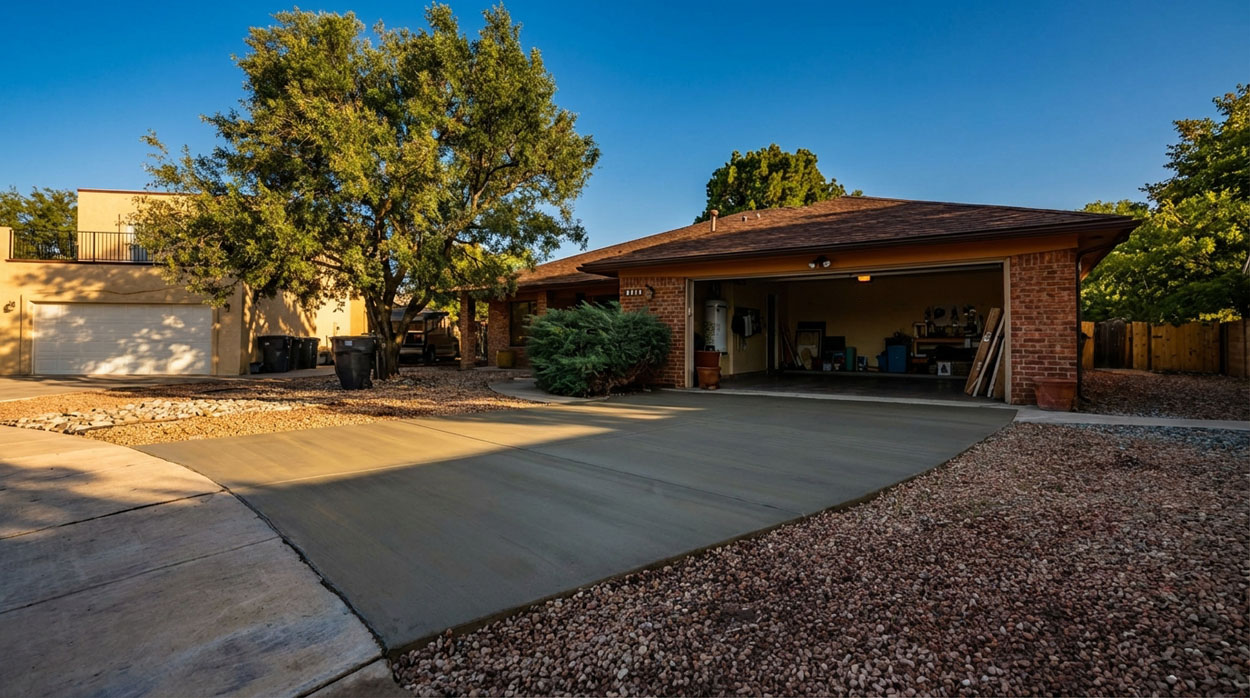 New residential concrete driveway pour in Rio Rancho
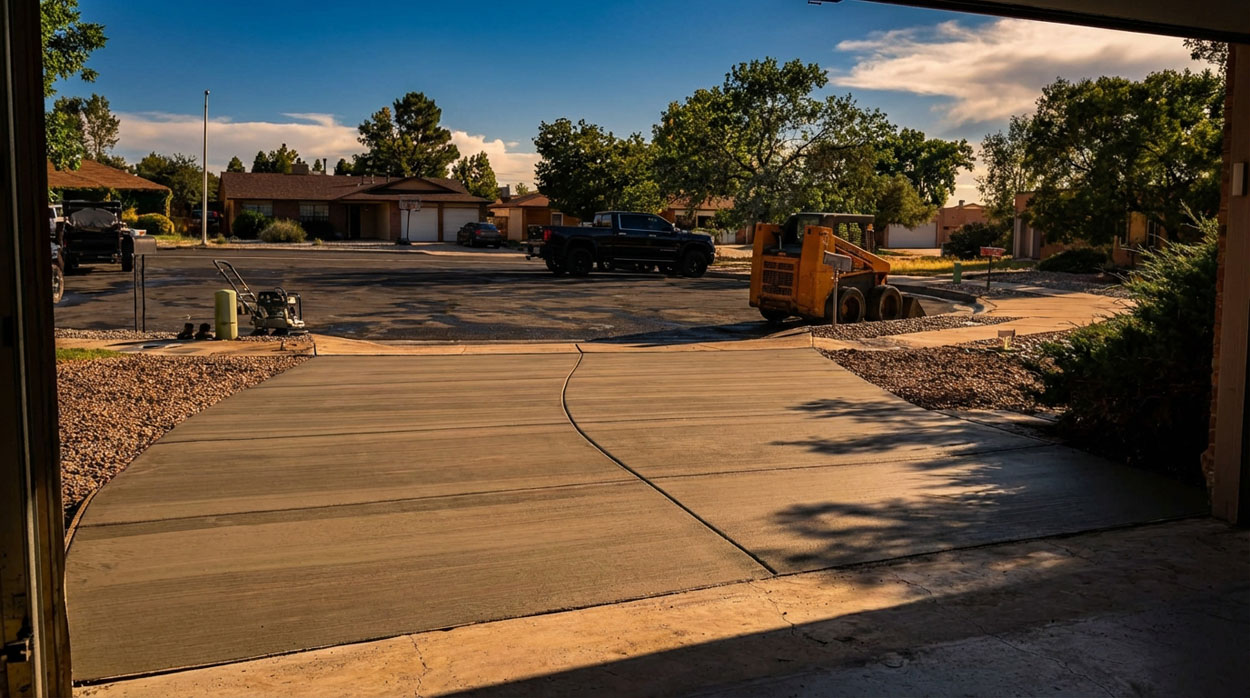 Finished residential concrete driveway in Albuquerque, NM
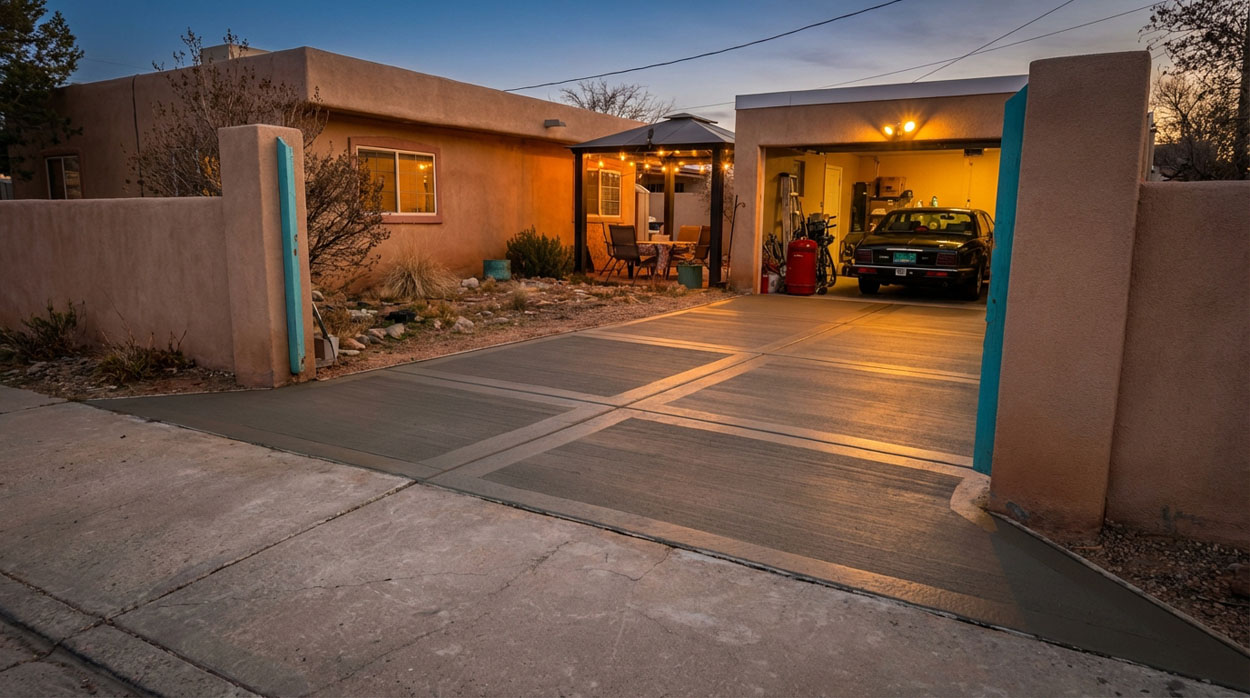 Concrete driveway for southwest-style home in Rio Rancho
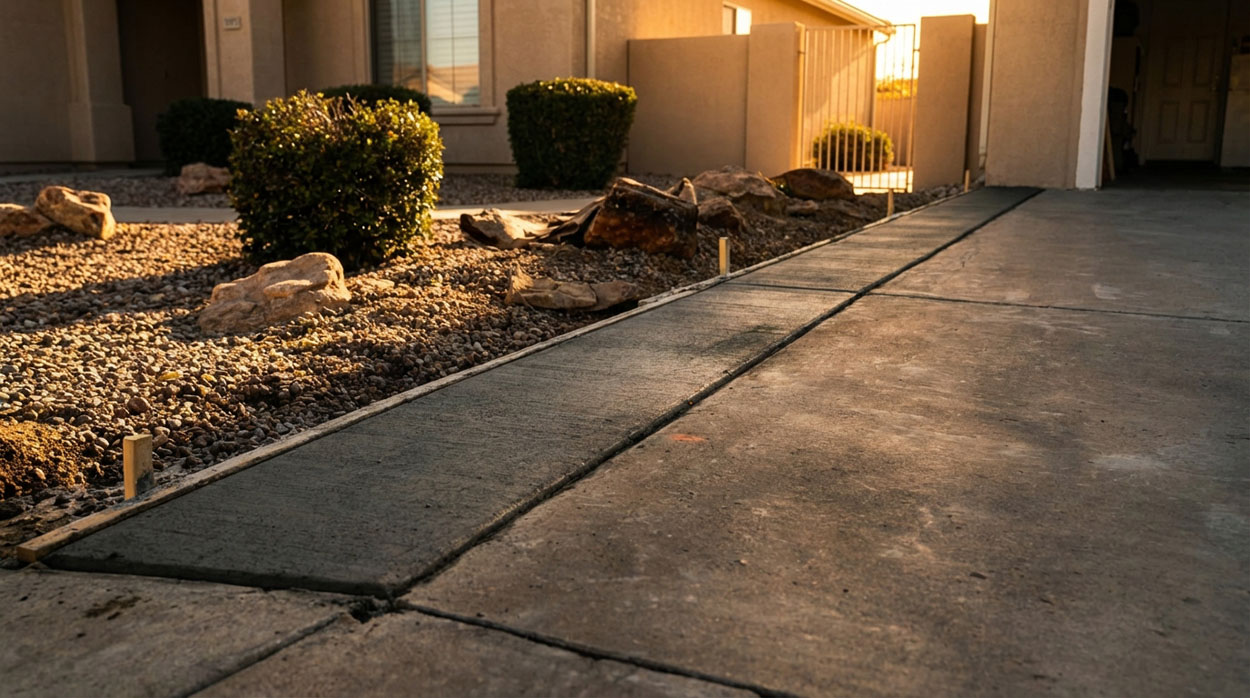 Concrete driveway widening and extension project
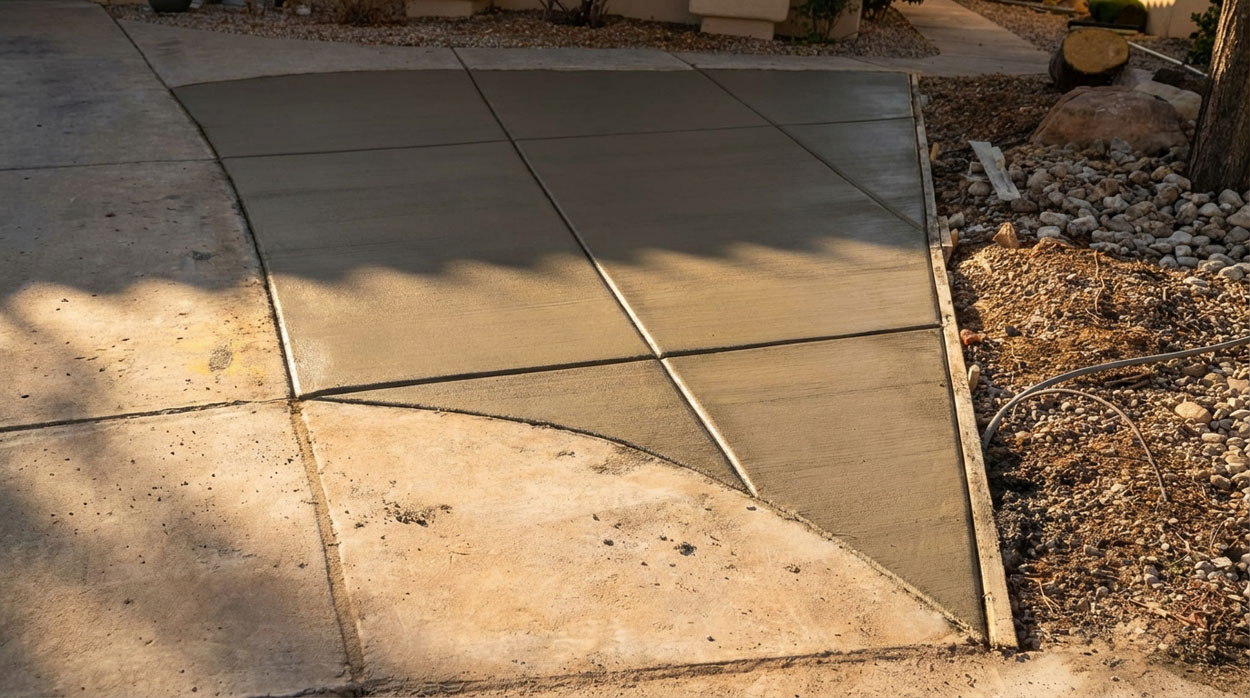 Fresh concrete driveway extension in Rio Rancho, NM
We've worked on properties throughout Corrales — from the large estates along the bosque to the horse farms on the upper piedmont. We understand the village's permitting requirements, including the Grading and Drainage Plan and the on-lot runoff retention rule that applies to every driveway pour. We know to check for acequia lines before excavating, to confirm well and septic setbacks before placing forms, and to adjust our sub-base approach depending on whether we're working in the inner valley's alluvial soil or the piedmont's sandy caliche. Corrales homeowners value craftsmanship and attention to detail — and that's exactly how we approach every project in the village.
Driveway cost in Corrales depends heavily on length, width, soil conditions, and finish type. Because Corrales lots are large (one acre minimum, many much larger), driveways can run 150 to 400+ feet — significantly more concrete, joints, and sub-base work than a typical suburban driveway. We provide a detailed written estimate after visiting your property and assessing the full scope of the project.
Yes. Corrales is an equestrian community, and we regularly pour barn pads, horse wash pads, trailer-loading aprons, tack room floors, and arena edging. We engineer these slabs for the specific load and drainage requirements of equestrian use.
Yes. The Village requires building permits for driveway construction, and a Grading and Drainage Plan prepared by a licensed engineer, surveyor, or architect. Additionally, all driveway runoff must be retained on your property — it cannot be diverted to public streets or adjacent ditches. We're familiar with these requirements and factor them into every project.
Many Corrales properties have active acequia (irrigation ditch) access. Concrete work near acequias requires careful planning to avoid disrupting the ditch, its banks, or water flow. We identify acequia locations before starting any project and plan excavation and pour areas to protect these features.
Corrales homes are predominantly adobe, territorial, and Southwestern in style. Stamped flagstone or sandstone patterns in earth tones (terra cotta, adobe tan, warm brown) complement these architectural styles. Smooth trowel finishes and exposed aggregate are also popular. We'll show you samples during the estimate to help you choose a finish that matches your home.
Yes. We work throughout the entire village — from the inner valley properties near the bosque with their higher water tables and clay soils, to the upper piedmont properties toward Rio Rancho with sandier soils and caliche. Each area has different soil and drainage conditions, and we adjust our approach accordingly.
Call or text (505) 480-7542 for a free estimate on driveways, patios, barn pads, block walls, or decorative concrete for your Corrales property. We understand the village's unique requirements and build to the standard its homeowners expect.